
Hip Dysplasia in Dogs: Treatment Costs and Insurance Reimbursement Examples


Hip Dysplasia in Dogs: Treatment Costs and Insurance Reimbursement Examples
Hip dysplasia is one of the most common — and most expensive — orthopedic conditions affecting dogs today. For owners of large and giant breeds especially, the moment a veterinarian utters the words "hip dysplasia" often triggers two immediate questions: How is this treated? and How much will it cost me?
To bring real clarity to those questions, we at PetPremium pulled together actual claim scenarios, surgical price ranges, and reimbursement examples so you can see what hip dysplasia treatment really looks like financially — and how pet insurance changes the math.
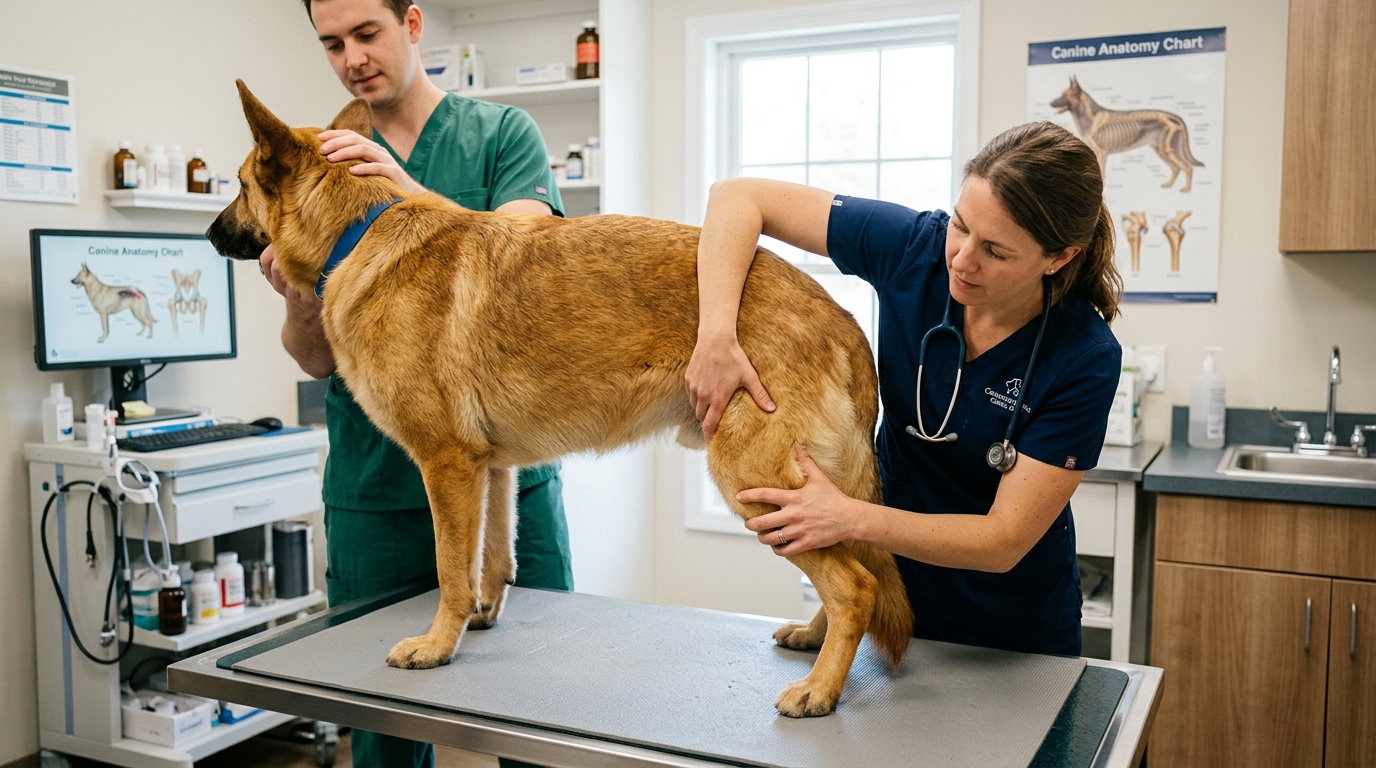
What Is Hip Dysplasia?
Hip dysplasia is a hereditary condition where the ball-and-socket joint of the hip develops abnormally. Instead of fitting smoothly, the femoral head grinds against the acetabulum, causing inflammation, cartilage damage, and progressive osteoarthritis. According to the American College of Veterinary Surgeons, it's most prevalent in large and giant breeds — German Shepherds, Labrador Retrievers, Golden Retrievers, Rottweilers, Bernese Mountain Dogs, and Saint Bernards top the list — though smaller breeds can develop it too.
Symptoms typically appear in one of two windows: between 4 and 12 months of age, or later in life as secondary arthritis sets in. Watch for:
- Bunny-hopping gait
- Reluctance to climb stairs or jump
- Stiffness after rest
- Looseness or "clicking" in the hips
- Loss of muscle mass in the hindquarters
- Difficulty rising
Treatment Options and Their Costs
Treatment falls into two broad categories — conservative management and surgical correction — and the right path depends on the dog's age, weight, severity of joint changes, and overall health.
Conservative (Non-Surgical) Management
For mild cases or older dogs, vets often recommend a multi-modal approach: weight control, physical therapy, joint supplements (glucosamine, chondroitin, omega-3s), NSAIDs, and sometimes injectable therapies like Adequan or platelet-rich plasma (PRP).
| Treatment | Typical Cost (Annual) |
|---|---|
| Veterinary exam + X-rays | $300 – $700 |
| NSAIDs (year-round) | $400 – $900 |
| Joint supplements | $200 – $500 |
| Adequan injections (series) | $300 – $600 |
| Physical therapy / hydrotherapy | $50 – $125 per session |
| PRP or stem cell therapy | $1,500 – $3,500 per round |
A dog managed conservatively can easily incur $1,500 to $4,000 per year in ongoing care.
Surgical Treatment
When conservative care isn't enough, surgery becomes the recommended path. There are four primary procedures, each with very different price points.
| Procedure | Best For | Typical Cost (Per Hip) |
|---|---|---|
| Juvenile Pubic Symphysiodesis (JPS) | Puppies under 5 months | $1,000 – $3,000 |
| Double or Triple Pelvic Osteotomy (DPO/TPO) | Young dogs (5–10 months) without arthritis | $3,000 – $5,000 |
| Femoral Head Ostectomy (FHO) | Smaller dogs, salvage procedure | $1,500 – $3,500 |
| Total Hip Replacement (THR) | Mature dogs with severe disease | $7,000 – $12,000 |
For a large dog requiring bilateral total hip replacement, total out-of-pocket costs can reach $14,000 to $24,000 when surgical fees, anesthesia, hospitalization, imaging, medications, and rehabilitation are added together.
Real Reimbursement Examples
Below are anonymized claim scenarios that illustrate what owners actually paid versus what insurance reimbursed. These reflect typical PetPremium-affiliated plan structures with an 80% or 90% reimbursement rate after a $250–$500 deductible is met.
Case Study 1: Bailey, 7-Year-Old Golden Retriever
Bailey developed worsening lameness at age 7. After conservative management failed, her vet recommended a unilateral total hip replacement.
- Diagnostics & pre-surgical workup: $1,180
- THR surgery, anesthesia, hospitalization: $8,400
- Post-op rehab (12 sessions): $1,500
- Medications: $320
- Total billed: $11,400
With a $500 annual deductible and 90% reimbursement on a covered policy, Bailey's owner was reimbursed approximately $9,810, leaving an out-of-pocket cost of about $1,590.
Case Study 2: Max, 9-Month-Old German Shepherd
Max was diagnosed early through OFA preliminary screening. His surgeon recommended bilateral DPO before arthritis could set in.
- Imaging (CT + radiographs): $920
- Bilateral DPO surgery (staged): $7,800
- Post-op care and rechecks: $640
- Total billed: $9,360
With a $250 deductible and 80% reimbursement, Max's family received roughly $7,288 back, paying about $2,072 themselves.
Case Study 3: Daisy, 11-Year-Old Labrador
Daisy's family chose long-term conservative management instead of surgery due to her age and heart condition.
- Year 1 management: $2,840 (NSAIDs, Adequan, supplements, PT, X-rays)
- Reimbursement at 90% after $500 deductible: $2,106
- Owner's out-of-pocket: $734
Over three years, the family submitted roughly $8,200 in claims and was reimbursed about $6,800.
The Critical Insurance Caveat: Pre-Existing Conditions
Here's the single most important thing to understand about hip dysplasia insurance: coverage hinges on enrollment timing.
Hip dysplasia is a hereditary and developmental condition. Most pet insurance plans cover it — but only if symptoms or a diagnosis did not exist before your policy's effective date and waiting period. If your dog limped, was X-rayed, or was diagnosed before coverage started, that condition will almost certainly be excluded as pre-existing.
Some insurers also impose a special orthopedic waiting period of 6 to 14 months specifically for conditions like cruciate ligament tears and hip dysplasia. Always read the policy's orthopedic clause carefully.
For more detail on how different insurers handle inherited conditions, see our companion guide Does Pet Insurance Cover Hereditary Conditions? A Plan-by-Plan Comparison.
Prevention and Early Detection
While you can't change a dog's genetics, you can dramatically reduce risk and severity:
- Buy from breeders who screen with OFA or PennHIP certifications (OFA database)
- Keep growing puppies lean — overfeeding large-breed pups is a major risk multiplier
- Use large-breed puppy formulas with controlled calcium and calorie density
- Avoid forced exercise on hard surfaces during the first 12–18 months
- Strengthen muscle mass through swimming and balanced low-impact activity
- Schedule preliminary OFA screening between 4–6 months for high-risk breeds — early diagnosis opens the door to JPS or DPO, which are far cheaper than later THR
Is Insurance Worth It for Hip Dysplasia–Prone Breeds?
The math tends to favor enrollment, especially for owners of breeds with elevated risk. Consider:
- A typical accident & illness policy for a large-breed puppy runs $45–$80/month
- That's roughly $540–$960/year, or $5,400–$9,600 over a 10-year lifespan
- A single bilateral THR can exceed $18,000
- Even one hip surgery typically returns more in reimbursements than a decade of premiums costs
PetPremium recommends enrolling before your puppy's first vet visit whenever possible — that's the cleanest way to ensure hip dysplasia and other hereditary conditions remain eligible for coverage.
If you want to compare quotes across PetPremium and our partner insurers (FIGO, Pets Best, Embrace, and PTZ), you can get personalized pricing in under two minutes.
Frequently Asked Questions
Q: How much does hip dysplasia surgery cost for a large dog?
Total hip replacement (THR), the gold-standard surgery for severe cases, typically costs $7,000 to $12,000 per hip in the United States. For dogs needing both hips replaced, total costs commonly run between $14,000 and $24,000 once diagnostics, hospitalization, and rehab are included.
Q: Does pet insurance cover hip dysplasia?
Most pet insurance plans cover hip dysplasia as long as it wasn't diagnosed or showing symptoms before your policy's start date and waiting periods. Many insurers apply a special orthopedic waiting period of 6 to 14 months, so enrolling early — ideally when your dog is a puppy — is critical.
Q: At what age does hip dysplasia usually appear?
Symptoms commonly emerge in two stages: early-onset signs between 4 and 12 months of age (when bones are still developing) and late-onset signs in middle-aged or senior dogs as secondary osteoarthritis develops. Early X-rays in at-risk breeds can detect joint laxity before clinical signs appear.
Q: Can hip dysplasia be treated without surgery?
Yes, mild to moderate cases can often be managed with weight control, physical therapy, NSAIDs, joint supplements, and injectable therapies like Adequan or PRP. Conservative care typically runs $1,500–$4,000 per year and can keep many dogs comfortable for years, though severe cases ultimately require surgery.
Q: Which dog breeds are most prone to hip dysplasia?
Large and giant breeds are at highest risk: German Shepherds, Labrador Retrievers, Golden Retrievers, Rottweilers, Bernese Mountain Dogs, Saint Bernards, Newfoundlands, and Mastiffs. Smaller breeds like Pugs and French Bulldogs can also develop it, though it's less common.
Q: Does PetPremium cover hip dysplasia treatment?
PetPremium and its partner insurers (including FIGO, Pets Best, and Embrace) generally cover hip dysplasia diagnostics, surgery, medications, and rehabilitation as long as the condition is not pre-existing and any orthopedic waiting period has been satisfied. We recommend enrolling puppies as early as possible to secure full eligibility for hereditary conditions.
Q: How can I lower my dog's risk of developing hip dysplasia?
Choose a breeder who provides OFA or PennHIP certifications for the parents, keep puppies lean during growth, feed a large-breed-specific puppy formula, avoid high-impact exercise on hard surfaces before 18 months, and build muscle through swimming or controlled walking. Early screening for at-risk breeds enables less invasive — and far less expensive — surgical interventions if dysplasia is detected.
Q: What's the difference between FHO and total hip replacement?
A femoral head ostectomy (FHO) removes the femoral head entirely, allowing the body to form a "false joint" of fibrous tissue — it's cheaper ($1,500–$3,500) and works best in smaller dogs. A total hip replacement (THR) installs an artificial joint with implants, restoring near-normal function and biomechanics, and is the preferred option for larger dogs despite costing $7,000–$12,000 per hip.
