
2026 Veterinary Cost Benchmark Report: Vaccines, Exams & Procedures


2026 Veterinary Cost Benchmark Report: Vaccines, Exams & Procedures
Veterinary care prices have shifted meaningfully over the past five years, driven by inflation, consolidation of independent practices into corporate networks, advances in diagnostic technology, and a sustained shortage of credentialed veterinarians. To help pet owners plan ahead, we at PetPremium compiled this 2026 Veterinary Cost Benchmark Report — a national snapshot of what routine wellness visits, vaccines, dental work, and common surgical procedures actually cost in the United States right now.
This dataset is designed for pet parents in the awareness stage: people researching what they should expect to spend before they bring home a puppy or kitten, schedule a senior wellness exam, or budget for an unexpected procedure.
Methodology
Benchmarks below reflect averages aggregated from claims data, published price surveys from the American Veterinary Medical Association (AVMA), the American Animal Hospital Association (AAHA), and pricing reported by general practice clinics across all U.S. regions in early 2026. Prices are presented as national ranges; your local cost will vary based on metropolitan area, clinic type (general practice vs. specialty/ER), and your pet's size, age, and health status.
All figures are in U.S. dollars and exclude tax. Specialty and emergency pricing is benchmarked separately because it typically runs 2–4× general practice rates.
Routine Wellness Exam Costs in 2026
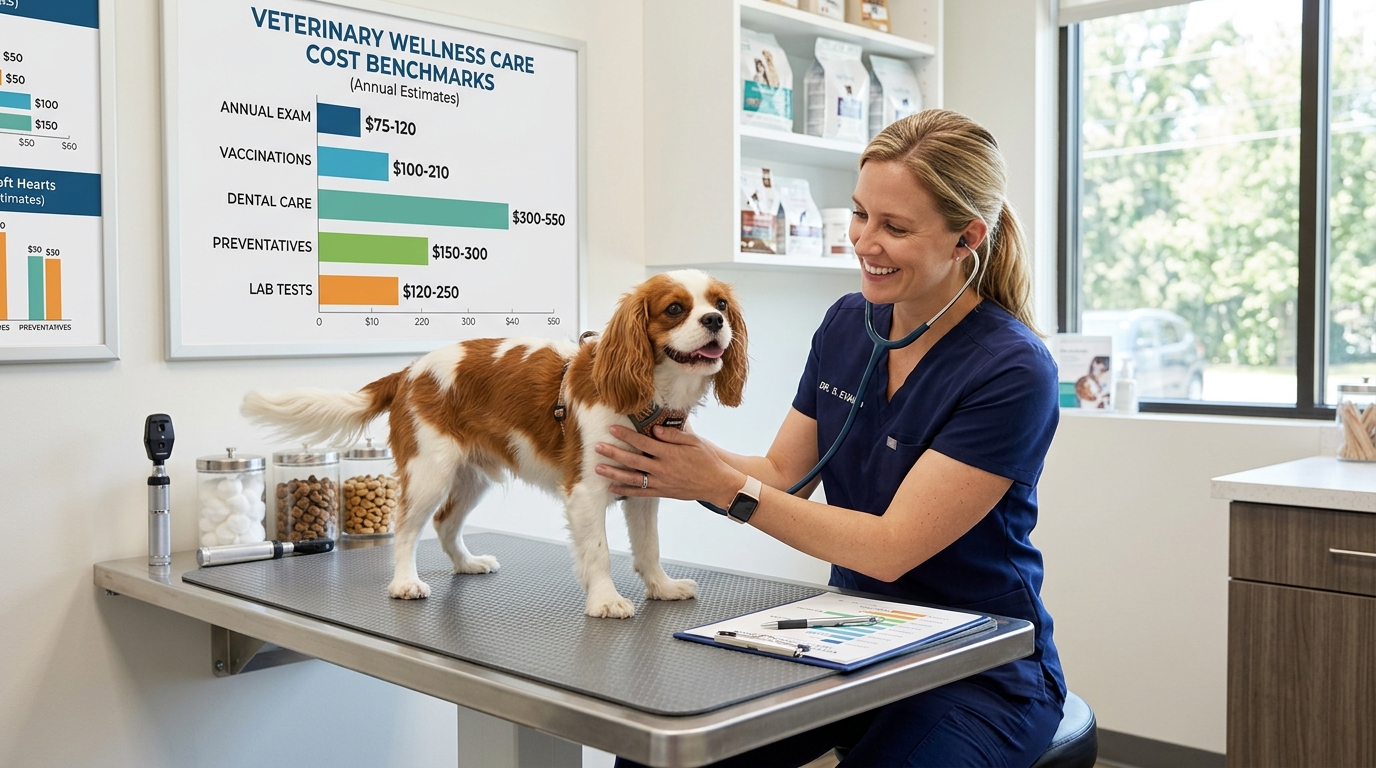
The annual wellness exam is the foundation of preventive care and the gateway to most vaccines, parasite screenings, and bloodwork. Costs have risen approximately 7–9% since 2024.
| Visit Type | Dog (Avg) | Cat (Avg) | National Range |
|---|---|---|---|
| Puppy/Kitten exam (first visit) | $85 | $75 | $55–$135 |
| Annual adult wellness exam | $70 | $65 | $50–$120 |
| Senior wellness exam (7+ years) | $95 | $90 | $70–$160 |
| Drop-in/recheck exam | $55 | $50 | $35–$90 |
Senior visits cost more because they typically include baseline bloodwork, urinalysis, and blood pressure screening — recommended annually under current AAHA senior care guidelines.
Vaccine Cost Benchmarks
Vaccines are typically priced individually or bundled into puppy/kitten "packages." Most clinics charge a vaccine administration fee on top of the dose itself.
Dog Vaccines (2026 Averages)
| Vaccine | Cost Per Dose | Schedule |
|---|---|---|
| DHPP / DAPP (core) | $35–$55 | Series + booster every 1–3 years |
| Rabies (1-year) | $25–$40 | Annual or triennial |
| Rabies (3-year) | $35–$55 | Every 3 years |
| Bordetella (kennel cough) | $30–$50 | Annual |
| Leptospirosis | $30–$45 | Annual |
| Lyme | $40–$60 | Annual |
| Canine influenza (CIV) | $40–$65 | Annual |
Puppy vaccine package (full series, 8–16 weeks): $180–$340 nationally.
Cat Vaccines (2026 Averages)
| Vaccine | Cost Per Dose | Schedule |
|---|---|---|
| FVRCP (core) | $30–$50 | Series + booster every 1–3 years |
| Rabies (1- or 3-year) | $25–$50 | Per label |
| FeLV (feline leukemia) | $35–$55 | Annual for at-risk cats |
Kitten vaccine package (full series): $150–$280 nationally.
Dental Cleaning & Oral Care
Dental disease is the #1 underdiagnosed condition in pets, and professional cleanings under anesthesia have seen some of the steepest price increases in 2026 due to rising anesthesia and monitoring standards.
| Service | Average Cost |
|---|---|
| Routine dental cleaning (no extractions) | $400–$900 |
| Cleaning with 1–3 simple extractions | $700–$1,400 |
| Cleaning with surgical extractions | $1,200–$3,000 |
| Dental X-rays (full mouth) | $150–$300 |
Cats often run slightly less than dogs for cleanings but more for extractions due to feline tooth resorption being notoriously time-intensive.
Common Diagnostic Tests
| Test | Average Cost |
|---|---|
| Heartworm test (4DX/SNAP) | $45–$75 |
| Fecal exam | $35–$65 |
| Complete blood count (CBC) | $75–$130 |
| Chemistry panel | $90–$160 |
| Urinalysis | $45–$85 |
| Thyroid panel (T4) | $55–$110 |
| Digital X-ray (1–2 views) | $150–$350 |
| Abdominal ultrasound | $400–$700 |
Spay & Neuter Pricing
| Procedure | Cost Range |
|---|---|
| Cat neuter | $120–$300 |
| Cat spay | $200–$500 |
| Dog neuter (small/medium) | $250–$550 |
| Dog neuter (large/giant) | $400–$800 |
| Dog spay (small/medium) | $350–$700 |
| Dog spay (large/giant) | $550–$1,200 |
Low-cost clinics and humane society programs can run 40–60% lower, while specialty hospitals offering laparoscopic spays charge a premium.
Common Surgical & Medical Procedures
These procedures are where unexpected costs hit hardest. The averages below reflect general practice pricing; specialty surgeons charge 1.5–3× more.
| Procedure | National Average Range |
|---|---|
| Mass removal (benign, simple) | $350–$900 |
| Mass removal with histopathology | $600–$1,500 |
| Cruciate ligament repair (TPLO) | $4,500–$7,500 |
| Hip dysplasia surgery (FHO) | $1,800–$3,500 |
| Bladder stone removal | $1,500–$3,200 |
| Foreign body removal (GI surgery) | $2,500–$5,500 |
| Cherry eye repair | $400–$900 per eye |
| C-section (dog) | $1,500–$3,500 |
| Chemotherapy (per session) | $200–$600 |
For ER-specific pricing, see our companion dataset on the Average Cost of Common Pet Emergencies in 2026, which benchmarks the top 20 emergency scenarios.
Parasite Prevention (Annual)
| Product Category | Annual Cost |
|---|---|
| Flea/tick prevention (dog) | $150–$320 |
| Flea/tick prevention (cat) | $130–$260 |
| Heartworm prevention (dog) | $90–$220 |
| Combination products (e.g., Simparica Trio, NexGard Plus) | $220–$420 |
Regional Pricing Variation
Geography is the single biggest variable in vet pricing. A spay in rural Mississippi can cost a third of what it does in San Francisco. Our Average Vet Costs by State 2026: Annual Wellness, Vaccines & Procedures breakdown shows full state-level benchmarks, but in general:
- Highest-cost markets: San Francisco Bay Area, NYC metro, Boston, Seattle, Los Angeles, Washington D.C. (typically 25–55% above national average)
- Mid-cost markets: Denver, Austin, Atlanta, Minneapolis, Chicago suburbs (near national average)
- Lower-cost markets: Rural Midwest, Deep South, Appalachian regions (often 15–30% below national average)
What This Means for Your Budget
A healthy adult dog will typically run $700–$1,500 per year in routine veterinary expenses. A healthy adult cat lands closer to $500–$1,100 per year. Senior pets, large breeds, and brachycephalic breeds (Frenchies, Pugs, Persians) consistently cost 30–60% more.
Where pet owners get caught off guard is the non-routine — the foreign body surgery, the cruciate tear, the cancer diagnosis. A single emergency hospitalization can exceed an entire year of routine care, and these are precisely the events pet insurance is designed to absorb. Comparing premiums against the procedure benchmarks above is the most honest way to evaluate whether a policy makes financial sense for your household.
If you'd like a personalized estimate based on your ZIP code, breed, and pet's age — including how monthly premiums compare to the procedure ranges above — you can get a quote in under two minutes.
Frequently Asked Questions
Q: How much should a routine vet visit cost in 2026?
A standard adult wellness exam ranges from $50 to $120 nationally, with most general practice clinics falling between $65 and $90. Add-ons like vaccines, fecal exams, and heartworm testing typically push the total visit to $200–$400 for a comprehensive annual checkup.
Q: Why have vet prices increased so much recently?
Three forces are driving the increase: a nationwide shortage of veterinarians and credentialed technicians, corporate consolidation of independent practices, and rising costs for pharmaceuticals, anesthesia equipment, and lab diagnostics. Inflation in veterinary services has consistently outpaced general CPI since 2022.
Q: Are vaccine costs covered by pet insurance?
Most accident-and-illness policies do not cover vaccines, but optional wellness or preventive care add-ons typically reimburse vaccines, annual exams, and parasite prevention. PetPremium offers wellness add-on options that bundle these routine costs alongside core illness coverage — you can compare what's included when you run a quote.
Q: What's the most expensive common veterinary procedure?
Among routinely performed procedures, TPLO (cruciate ligament repair) is consistently the costliest, ranging $4,500–$7,500 per knee. Foreign body GI surgeries, oncology treatment, and orthopedic specialty procedures also regularly exceed $5,000.
Q: How can I lower my vet bill without compromising care?
Schedule preventive visits on time (catching disease early is dramatically cheaper than treating advanced cases), ask your vet for written estimates and itemized invoices before procedures, compare prices for elective surgeries, use low-cost spay/neuter and vaccine clinics for routine care, and consider pet insurance to convert unpredictable large bills into predictable monthly premiums.
Q: Does PetPremium help estimate procedure costs before I commit to a policy?
Yes. We at PetPremium provide tools like a Vet Visit Cost Calculator by ZIP Code and a Vet Cost Estimator covering 50+ common procedures so pet owners can see realistic local pricing before deciding on coverage. Our quote process also factors in your pet's breed and age to project expected lifetime care costs.
Q: Is pet insurance worth it given current vet prices?
For most pet owners, yes — particularly for breeds with known genetic predispositions (covered throughout our Breed Health Atlas series). When a single ACL surgery or foreign body removal can cost $4,000–$7,000, paying $30–$70 monthly for insurance often pays for itself with a single claim over the pet's lifetime. The math is weakest for owners who can comfortably self-fund a $10,000 emergency and strongest for households where an unexpected bill would mean difficult financial choices.
Q: How often should adult pets see the vet?
Healthy adult dogs and cats should have a wellness exam annually. Pets aged seven and older should be seen every six months, since age-related conditions like kidney disease, arthritis, dental disease, and cancer progress quickly and are far cheaper to manage when caught early.
